The first to ty every cloud dollar to the Git commit that caused it
.png)
Code creates infrastructure. Infrastructure creates cost. What if we could connect the two?
Cloud cost tools are great at showing what happened.
A dashboard lights up. A line goes up and to the right. A cost spike appears.
But they rarely tell you why.
Today, when you see a spike, you’re left asking:
- Which code caused this?
- Which team owns it?
- Is this expected… or accidental?
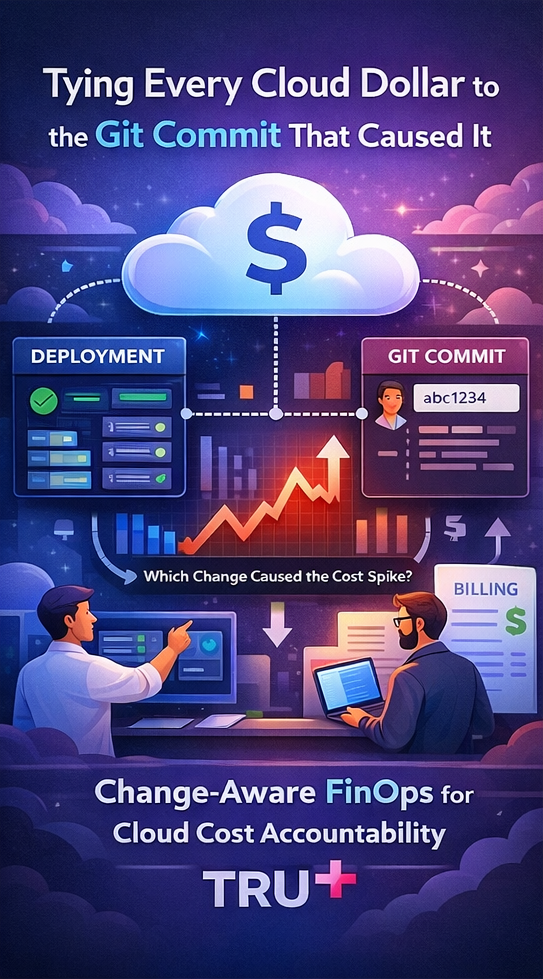
Those answers don’t live in cost dashboards. They live in Git.
And that gap is exactly what we’re fixing.
Every Cloud Resource Should Know Where It Came From
Picture this. It’s 3:00 AM. Production is down. Your on-call engineer gets paged.
They find the failing resource quickly — a storage account. But then comes the real problem:
Which code created this resource?
Right now, most teams can’t answer that.
You may have tags: team names, project IDs, cost centers. FinOps can tell you who owns the resource. But they can’t tell you which commit created the $2,000/month cost behind it.
Cloud infrastructure has no memory of the code that created it.
When Costs Spike, Guessing Gets Expensive
A week later, FinOps reaches out:
“Your team’s cloud costs increased 40% last month. What changed?”
Without a direct link between cost and code, you’re stuck guessing.
Was it:
- A storage change?
- A new caching layer?
- An experimental feature that quietly made it to production?
Now engineers are diffing commits, matching timestamps, and debating intent. That costs time. And time costs money.
Enter TRU+ to link Cloud Costs to Code Changes
TruPositive is launching a thin wrapper around Terraform that makes cloud costs traceable to code.
We are changing how Infrastructure as Code is practiced — not by replacing Terraform, but by extending its best practices to include cost ownership and control.
With TruPositive, every cloud resource carries its DNA:
- The Git commit that created it
- The branch it came from
- The repository it belongs to
Think of it as a birth certificate for your infrastructure.
What TruPositive AI Does
When Terraform runs in CI/CD, TruPositive AI automatically:
- Reads Git context (commit SHA, branch, repository)
- Injects that context into Terraform as standard variables
- Tags all created cloud resources with this Git metadata
Terraform then runs unchanged.
Cloud providers record these tags natively, and they flow directly into:
- AWS Cost and Usage Reports (CUR)
- Azure Cost Management
- GCP Billing Export
All infrastructure is created by code.
TRU+ makes sure costs remember which code created them.
How to get started
- Engineers install the TRU+ Terraform wrapper
- Infrastructure is still deployed using their existing workflow, but with our TRU+ tag to monitor the cost impact of code changes
- FinOps grants us access to the Cost and Usage Report (CUR), and engineers install our GitHub App
- The customer starts generating cloud costs, and we report anomalies
- We link costs to code changes and deployments using our tags and the GitHub App
From Cost Numbers to Root Causes
Because cloud costs now carry Git metadata, you can:
- Track cost per commit
- Track cost per repository or application
- Track cost per environment (branch)
- Link costs directly to teams and features
All using native cloud billing data — no custom ingestion, no parallel systems.
Now, when FinOps asks about a spike, you can answer:
“It came from commit ABC123 in the storage module. Here’s the PR. Here’s what changed. Here’s why the cost increased.”
When Production Breaks, Answers Are Instant
Back to that 3:00 AM outage.
Your on-call engineer sees:
“This resource was created by commit XYZ789 on branch feature/new-cache.”
No Git archaeology.
No timestamp matching.
No guessing.
Rollback becomes precise: filter by Git SHA and target exactly the resources that change introduced.
Cloud Costs Show Numbers — We Give you the Root Cause
Cloud cost tools show numbers.
TruPositive shows which code changes caused the cost increase.
We are the first to link code to cost — and cost back to code.
You install it once. You initialize it per project. Then you keep using Terraform exactly as you do today.
The difference is simple but fundamental: The next time costs spike, you’ll know why.
And the next time production breaks at 3:00 AM, you’ll know exactly which commit to check.
This is a new class of FinOps tooling: Change-aware FinOps
And in important milestone in our vision to achieve Runtime FinOps.
Related posts
Discover further insights: browse related articles.