Do you need a FinOps Forensic Operator?
%20(2).png)
Lately, I’ve seen several people arguing for a new role in cloud cost management: the FinOps Forensic Operator.
The framing by FinOps evangelist Benjamin Van Der Maas resonates with me. Cloud environments are complex. Costs spike. Nobody knows why. Root cause is rarely obvious. And yes — human intuition and domain expertise are definitely valuable.
So naturally, you need a specialized person — or even a team — to investigate cost anomalies, trace root causes, and drive accountability.
I agree with most of that. But here’s the real question: How much of that work should still be manual? And how much of it can — and should — be accelerated by intelligent systems?
Let me explain.
The Real Problem Isn’t Investigation — It’s Friction
Most companies don’t struggle because they lack data analysts.
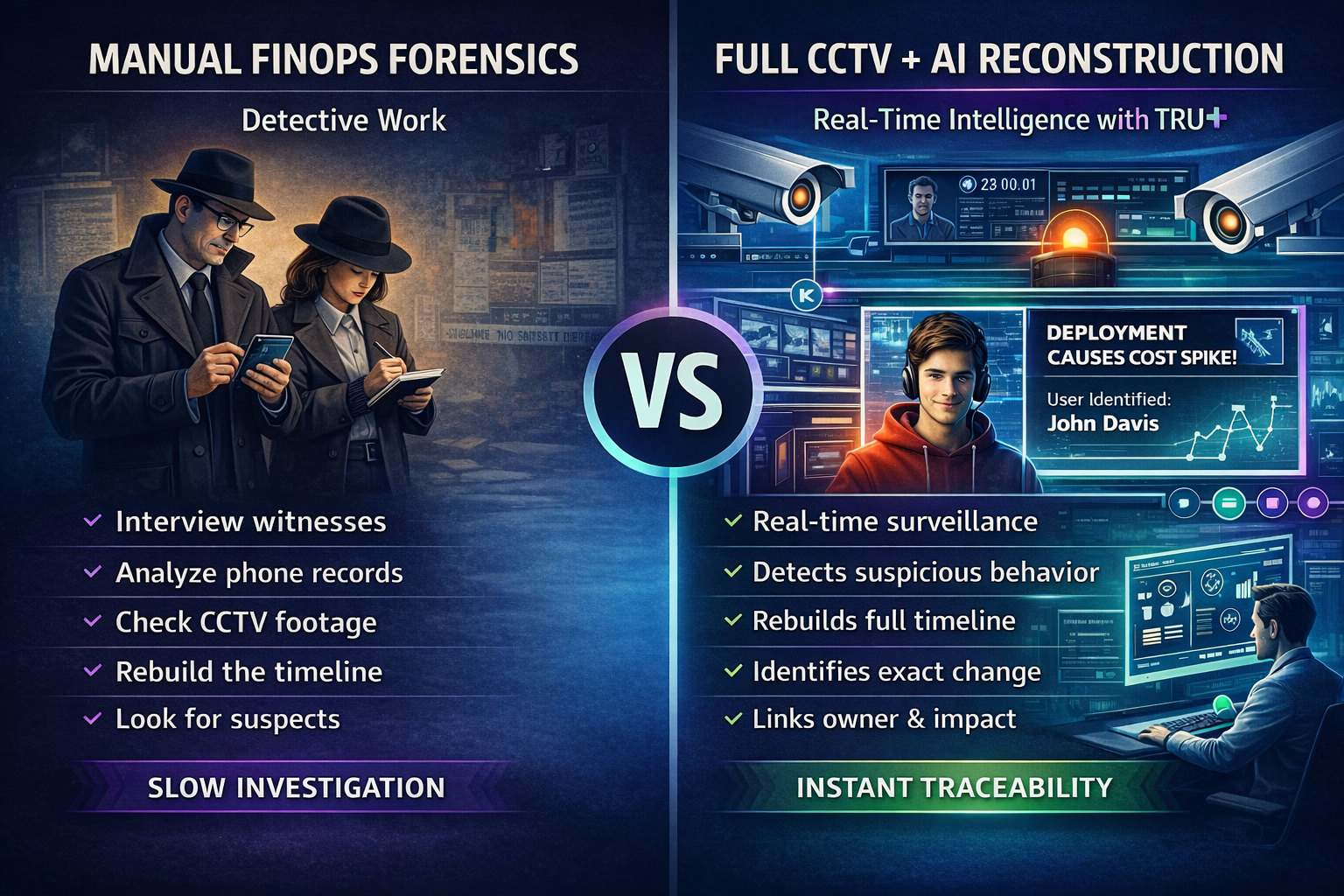
They struggle because their systems lack intelligence. When a cost spike happens today, the workflow usually looks like this:
- Unreliable alert fires.
- FinOps pulls reports.
- Dashboards get sliced 12 different ways.
- 5 different platforms are opened to manually look for correlations
- Slack threads start.
- Engineers get looped in.
- Someone asks: “What changed?”
- Days pass.
That entire loop exists because the tooling stops at visibility.
It shows you that something changed —but not why it changed, not who changed it, not which pull request introduced it, and not which team owns it.
So organizations create a “forensic layer” of FinOps analysts to bridge the gap.
And that makes sense. But it’s also compensating for tooling limitations.
Investigation Is a Pattern Recognition Problem
Let’s be honest about what most cloud cost deviations are:
- A deployment that changed scaling behavior
- A configuration drift
- An inefficient query introduced in a release
- A workload that stopped downscaling
- An architectural regression
- Orphaned infrastructure
These are not philosophical mysteries. They are pattern recognition problems across:
- Cost signals
- Infrastructure changes
- CI/CD activity
- Application behavior
- Ownership metadata
Humans are not built to continuously scan millions of signals across these layers. Systems are.
That doesn’t remove the need for domain expertise. It just changes where that expertise should be applied.
What Happens When Intelligence Is Built In
If you have an intelligence layer like TRU+, the flow looks completely different.
A cost deviation happens. Instead of: “is this relevant?” and “We need to investigate this.” You get:
- Automatic detection of statistically significant deviation
- Immediate correlation with infrastructure and deployment changes
- Identification of impacted service
- Link to the exact pull request
- Clear team ownership
- Quantified financial impact
No dashboard slicing. No Slack archaeology. No manual triage.
The system doesn’t just alert. It auto-investigates.
And this is where nuance matters: This doesn’t replace the FinOps Forensic Operator, but it does dramatically accelerates them.
Instead of spending hours reconstructing timelines, they start with context already assembled.
Instead of asking “what changed?”, they ask: “Is this behavior expected? And what is the right structural fix?”
That’s a very different use of their time and expertise.
Alert Triage Is Not a Job — It’s a Failure Mode
One of the arguments for a FinOps Forensic Operator is alert triage. But let’s call it what it is: If humans are triaging cost alerts all day, the system is broken. Manual triage is expensive and inefficient. Good intelligence should:
- Filter noise automatically
- Group related anomalies
- Prioritize by financial impact
- Route insights to the right team
If you still need an analyst to interpret every alert, you don’t have intelligence — you have manual monitoring. And this doesn’t scale.
The forensic operator’s time is far better spent on judgment and improvement, not filtering noise.
Centralized Forensics Can Slow Engineering Learning
Another unintended consequence of a purely centralized forensic team: It inserts a layer between engineering and cost ownership.
Instead of engineers seeing: “Your deployment increased compute cost by 22% due to scaling parameter X.” They hear: “FinOps is investigating something.”
That delay reduces accountability. It also slows learning from consequences. When insights go directly to application teams — linked to their code and their financial impact — ownership improves dramatically.
Engineers learn faster when they see the impact of their actions in near real-time. FinOps becomes embedded, not centralized. And the forensic operator shifts from being a gatekeeper to being an enabler.
Knowledge Should Compound
There’s another dimension here that often gets overlooked. Manual forensic investigations often live in:
- Slack threads
- Personal notes
- Tribal memory
When someone leaves, knowledge leaves with them. With intelligent systems like TRU+:
- Root cause patterns are structured
- Insights are stored
- Best practices are captured
- Similar anomalies are recognized faster next time
The operator becomes more effective over time — not because they personally remember everything, but because the system remembers with them. That creates continuous improvement at scale.
The Scaling Reality
Cloud environments don’t grow linearly. They grow in:
- Services
- Microservices
- Deployments
- Teams
- Experiments
If your response to complexity is: “Let’s hire more forensic operators.” You are choosing linear cost to fight exponential complexity.
That doesn’t end well.
An intelligence layer scales far better than headcount ever will. And it makes each forensic operator significantly more productive.
This Is a Maturity Question
Investing in a FinOps Forensic Operator or team is not “wrong.”
Benjamin is right to emphasize the need for deeper cost intelligence and domain expertise. But maturity isn’t about adding more human investigation. It’s about augmenting that investigation with automation. In lower-maturity environments where:
- Tooling only provides visibility
- Correlation is manual
- Ownership mapping is unclear
- Investigation is dashboard-heavy
A forensic role makes sense. In higher-maturity environments:
- Detection is automated
- Correlation is instant
- Root cause is pre-assembled
- Insights are routed directly to engineers
The forensic operator evolves. They focus on:
- Architectural improvements
- Preventive guardrails
- Optimization strategy
- Financial engineering
- Coaching engineering teams
Not just digging through logs to answer “what changed?”
I’m pretty sure Benjamin would agree with me. He and his colleagues at J&J have been building a smart cost anomaly monitoring system to accelerate cost investigations and, most importantly, make advanced cost analysis accessible to a much broader audience at J&J—driving bottom-up cost ownership and optimization, exactly as we envision it.
The Real Competitive Advantage
While investing in a team of expert FinOps analyst is definitely still valuable, the companies that win in cloud efficiency won’t be the ones with the biggest FinOps forensic teams. They’ll be the ones that:
- Detect instantly
- Diagnose automatically
- Route intelligently
- Remediate faster
- Learn continuously
And they’ll do it with human expertise augmented by intelligent automation
Not scaled through manual triage.
Because when your system can auto-investigate cost deviations, correlate context across layers, trace root cause to code, store learnings in a knowledge base, and feed insights directly to engineers…
You don’t eliminate the FinOps Forensic Operator. You elevate them.
And that’s not just cost optimization.
That’s operational leverage.
That’s structural advantage.
Related posts
Discover further insights: browse related articles.